

Caught in a Backroom Nightmare
Hauntology, Eeriness, and the Architecture of Nowhere

What gives the Backrooms phenomenon its disturbing power? What is its connection to eeriness? From its origins on 4chan to Kane Parsons’ analog-horror adaptation, this article explores the unsettling nature of Backrooms imagery, continuing a thematic series on the aesthetics of unease and the analysis of emotional spaces. Through endless empty rooms, disorientation, and purposeless design, the Backrooms evoke a tension in which intentionality is suggested but meaning remains elusive.
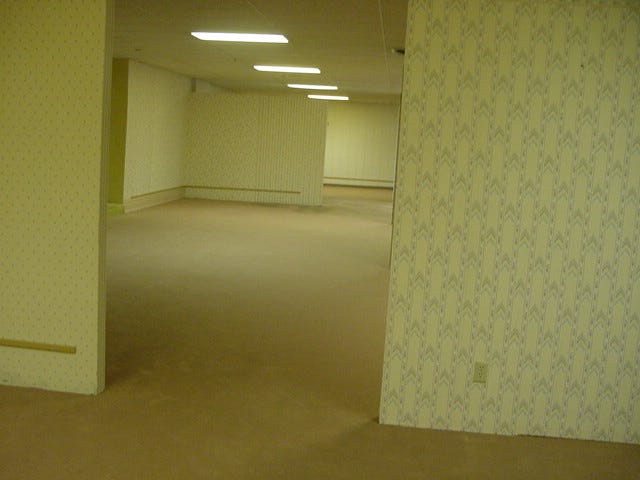
It is May 2019 when a slightly tilted image of a yellow corridor is posted on the website 4chan. The trigger of a chain reaction – unintended yet provoked – carrying a massive load of anxiety and unease. The user’s request, infused with that paradox typical of thrill seekers, is to “post [further] disquieting images that just feel ‘off’.” The explicit search for discomforting images, however, soon becomes stuck on the difficulty of conceptualizing the very object being sought. The quotation marks around the word “off” testify to this. In what sense do these images feel off? Which element contains the disturbing potential of the image?
Despite the vagueness of the request, users do not hesitate to respond, posting in turn images perfectly fitting with the feeling lurking behind the first one. A sequence of blurred images, mostly of undefined places and situations, lost in time and space, unfolds before the viewer. There are no monsters in sight, no suspicious figures lurking, no run-down urban neighborhoods. On the contrary, a sinister presence hovers over the images, yet never takes shape. Or rather, the image is imbued with a fear that terrifies precisely because it has no form – because it cannot be rationalized into a precise shape.
Let us return to the first image, the model for every future backroom. What do we see? Nothing more than a yellow corridor leading from one room to another. The scene is lit by a neon light, yellow and sickly. No door restricts the passage, and no window opens to the outside world. The corridor, the neon light, the wallpaper, the floor – traces of human presence could hardly be more evident, and yet the place seems stripped of any actual human presence. If the corridor is empty, what is its purpose? If there is no one there, for whom was the light switched on? What direction should one move toward – or is there a direction at all? How does one enter, but especially, how does one escape from this nightmare?
The most effective summary, and the most terrifying exemplification, of what a backroom is can be found in the work of YouTuber and filmmaker Kane Parsons (known online as Kate Pixels). His web series on the backrooms begins with the chilling short movie The Backrooms (Found Footage). Following the tradition of other analog horror movies, such as The Blair Witch Project, the video echoes the worn aesthetic of low-fidelity (lo-fi) graphics – produced through the use of old-style camcorders – and the rhetorical narrative of found footage.
According to the description below the video, the author pretends to be uploading to YouTube a video dating back to September 23rd, 1996. The story opens with a group of people – presumably friends – filming an amateur video with a vintage camcorder. Two strange individuals, one of whom is wearing a monkey mask, have just finished acting, when the presumed director of the footage gives the cameraman final instructions before ending the shooting session. And here the unsettling dimension of the backroom manifests itself: the cameraman steps backwards in confusion, as if tripping, and is suddenly catapulted into a backroom, through the mechanism known as “noclipping.” This is an expression that, in videogames, refers to a cheat that allows a player to move through solid objects, such as walls and floors. Within the context of the backrooms, it takes on a more specific meaning: the phenomenon of accidentally “falling” or “glitching” through common reality into a different level of reality itself. A level that presents itself as a non-place, a structure that cannot be located by any spatial coordinate, a space with no possible access and, above all, no possible escape.
After a brief cut, the camera begins recording images of the interior of a backroom – images eerily similar to the one posted on 4chan. Around the boy stretch sickly neon lights, left on by no one for no one, senselessly, and empty rooms devoid of people and meaning that follow one another endlessly. The color yellow dominates the scene, while the rooms give way to more rooms, through corridors each different yet united by their lack of meaning and purpose. What is so terrifying, then, about the backroom? The absolute vacuity of the space being traversed. Who built this infernal labyrinth, one that has neither entrance nor exit? The absence of acting subjects weighs heavily on the viewer’s mind. Each time the camera frames a point in the distance – the end of a corridor or the narrow gap between two walls – the viewer is torn between the fear that something terrible is about to happen and the hope that something, finally, will happen, thus releasing the mounting tension. It is an anxiety fueled by a paradoxical hold: on one hand, nothing happens, except the empty succession of one room after another; on the other hand, everything has already happened, since the protagonist has been projected into an alternate dimension.
The intensity of the video rises when arrows begin to appear on the walls, pointing toward a path that leads to the climax of anxiety. The cameraman finds himself before a wall on which menacing eyes are drawn, and beneath them various writings, among which stands out: “DON’T MOVE STAY STILL!”. The moment the monster of the place reveals itself with a sharp scream allows the viewer, paradoxically, to transform their unease. At least vagueness is replaced by a definite figure, and the terror can once again be framed within the usual tropes of horror cinematography. The monster chases; it wants to kill. The victim runs; he must hide. No matter how fast he runs, his fate is to be caught again and again, until his death.
Fortunately, Kate Parsons chooses to surprise us once again, restoring originality to his work. When the monster is now close to its prey, the pursued cameraman decides to throw himself (or is thrown?) into the void in an attempt to save himself. Against all expectations, the scene suddenly changes once more. The noclipping phenomenon occurs again, and the cameraman reappears in the sky, above a city, in free fall toward the ground. The impact will mark his death, while the camera keeps filming aimlessly, fixed ahead.


Let us return once more to the initial question: in what sense do these images (or videos) feel off? Which element contains their disturbing potential? More specifically, what kind of anxiety dominates the scene?
The English philosopher Mark Fisher provides us with a guide through this conceptual labyrinth. In his 2016 analysis, he places alongside the well-known phenomenon of the uncanny two other privileged aesthetic categories: the weird and the eerie, a pair that also gives the title to his work. In particular, the analysis of the eerie highlights an essential feature of the aesthetic experience of the backrooms. Among other cases, the eerie emerges whenever there is a disjunction between intentionality and acting subject, such that the viewer perceives an intentional design without being able to identify the acting subject responsible for it.
“We find the eerie more readily in landscapes partially emptied of the human. What happened to produce these ruins, this disappearance? What kind of entity was involved? […] The eerie is fundamentally tied up with questions of agency. […] The eerie concerns the most fundamental metaphysical questions one could pose, questions to do with existence and non-existence: Why is there something here when there should be nothing? Why is there nothing here when there should be something?”
– Mark Fisher, The Weird and the Eerie, Repeater 2017, pp. 11–12
This is the sense in which backroom images “feel off”! They are not, nor could they be, the result of chance; instead, they embody someone’s intentionality – someone who created them exactly as they are: who set up the lights? Who designed such a labyrinthine network of identical rooms, and why? Who planned rooms devoid of any object? At the same time, however, it is impossible to identify anyone who might have actually designed and built the backrooms. And this holds in principle! It is not a matter of time: we do not know who made them, nor can we ever know at all, no matter how long or deeply we investigate the phenomenon. The disjunction between intentionality and acting subject prevents the backrooms from being rationally framed within classic patterns of comprehensibility. The rooms pile up without direction, without cause, without individuals, without signals, without any purpose. One enters without reason, and without reason (perhaps) one exits. No Minotaur inhabits this labyrinth. No final trial to undergo. No guilt to redeem. There is no Sphinx asking us a riddle to solve, because the riddle has always already been withdrawn from rational solutions. We have been robbed of any cathartic possibility that might, for better or worse, grant us relief – even post mortem. The atmosphere remains tense precisely due to the absence of twists: each step forward is a slow sinking into a swamp of anxiety, a gradual aesthetic drip. As happens to the protagonist of A Forest, played by The Cure, we have irrationally followed a female voice leading us into the depths of the woods. When we realize that no girl is emitting that voice, it is already too late. Trees replace other trees, in an incessant and senseless alternation, and all we are left with is a hollow, corrosive wandering. Again, and again, and again, and again…
This piece is the second in a series of thematic articles at YO-ME 読め engaging with hauntology, the aesthetics of emotional spaces, and the subtle mechanics by which images and narratives unsettle our sense of the familiar. The first instalment in the series explored the uncanny through psychoanalytic and cultural theory and is available here.
References
Fisher, Mark. The Weird and the Eerie. London: Repeater Books, 2016.
Parsons, Kane (Kane Pixels). The Backrooms (Found Footage). YouTube video, uploaded January 7, 2022. (source)
Anonymous, Unsettling Images. Post disquieting images that just feel “off”. Thread on 4chan board “/x/ – Paranormal”, May 2019. (source)
Daniel Myrick and Eduardo Sánchez (dirs), The Blair Witch Project, 1999.
The Cure, “A Forest”. Track 2 on Seventeen Seconds, 1980.